FlowShift
The method.
A system for organizing digital projects. Bringing order to chaos—with rigor, sequence, and governance.
Why FlowShift
The problem is notthe tool
. It's the foundation.
Most organizations seek to solve their digital problems by adding tools, resources, or speed. The result: more complexity, not less.
FlowShift starts from the opposite perspective. Before executing, we structure. Before accelerating, we sequence. Before equipping, we govern. It is this inversion that creates sustainability.
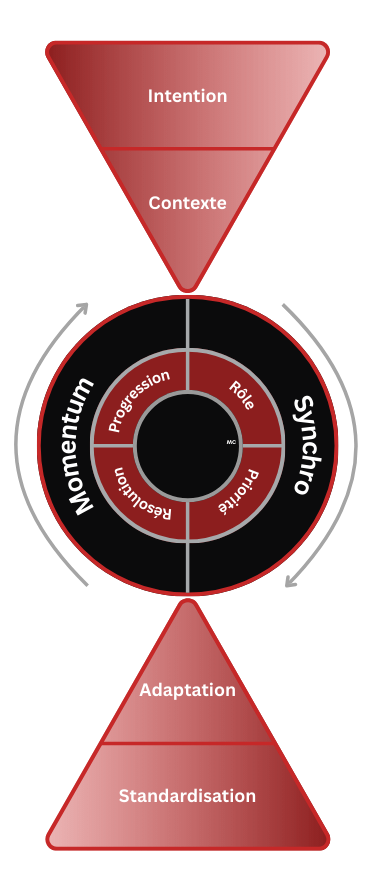
FlowShift OS
The system's operational engine
.
Getting started begins with clarifying what is really wanted—and in what specific context.
The operational core: four continuously active levers, with Momentum and Synchro as the driving forces.
What works adapts first, then becomes standardized—to become autonomous and sustainable.
"Structure before executing.
Govern beforeequipping."
The three phases
A three -movement system in
.
Architecture
Before taking any action, you need to see. Map out what already exists, identify unresolved decisions, understand where complexity really lies—not where you think it is.
Most blockages are not where we think they are. Architecture reveals the real points of friction, redundancies, and hidden priorities.
What it produces
- Mapping of ongoing projects and decisions
- Identification of critical interdependencies
- Organizational maturity assessment
- Clear view of the real complexity
Before / After
Before
Multiple projects, unclear priorities, each team working in isolation, no one really knows where things stand overall.
After
Comprehensive overview. Each project positioned within a global framework. Critical decisions identified and prioritized.
Sequence
Once the architecture is clear, the question becomes: in what order? Not everything can be a priority. Sequencing is the art of deciding what should come before what—and why.
Speed without sequence amplifies chaos. The right sequence transforms even a complex context into manageable execution.
What it produces
- Logical order of organizational priorities
- Sequential and realistic roadmap
- Identification of critical dependencies
- Alignment of management with the sequence
Before / After
Before
Everything seems urgent. Teams are exhausting themselves on initiatives that do not create sequential value. We are moving forward, but without clear progress.
After
A roadmap that everyone understands. Each step prepares for the next. Energy is focused where it creates the most leverage.
Governance
Governance is not bureaucracy. It is the implementation of decision-making mechanisms that allow teams to move forward on their own—without constantly seeking validation.
My ultimate goal is to make myself redundant. A well-governed organization no longer needs an external architect—it carries its own structure.
What it produces
- Clear and documented decision-making framework
- Defined roles and responsibilities
- Monitoring and adjustment process
- Autonomous and aligned teams
Before / After
Before
Decisions are systematically escalated. Management is in a bottleneck. Projects are waiting for approvals that never come.
After
Teams make decisions within their scope. Management focuses on strategy. Execution becomes smooth and predictable.
For whom
FlowShift is for you
, if you recognize yourself here.
Growing SME
Your digital projects are multiplying faster than your ability to manage them. The team is moving forward, but without a unified direction.
Structured associations & non-profit organizations
You have limited resources and multiple stakeholders. Every digital decision must be justifiable and sustainable.
Institutions in transition
You are undergoing digital transformation, but projects are piling up without a clear framework. Management is losing track of what is really progressing.
Management regaining control
You sense that something is not quite right with the digital execution, but you can't quite put your finger on it.
Get started
Ready to restoreorder
?
The first step is not to implement FlowShift—it's to check whether your situation is suitable for it. A conversation is all it takes to find out.