If you'd like to discuss this for your organization, here is my Calendly link to schedule a 30-minute meeting.
Most of the small and medium-sized businesses I meet already have Microsoft 365. Often they’ve had it for years. Often, it’s underutilized.
In addition, they’ve added other tools to their arsenal. A WordPress site for their online storefront. A CRM for contacts. QuickBooks for accounting. Mailchimp for emails. Slack or Teams for communication. Sometimes Shopify for the online store. A project management tool somewhere.
Each tool does its job quietly. Good.
But information isn’t flowing. Teams are entering data twice. No one has the full picture. And when it comes time to make a decision based on the actual data, we spend three days compiling Excel files.
This is the most common gap I see. It’s not a lack of tools. It’s a lack of connection between them.
What I’ve been telling executives for the past two months
Here’s what I’ve found after testing this in my own company: you’re much closer than you think to building a robust architecture.
Not with yet another SaaS solution. Not by replacing what already works. By adding a layer on top that coordinates everything.
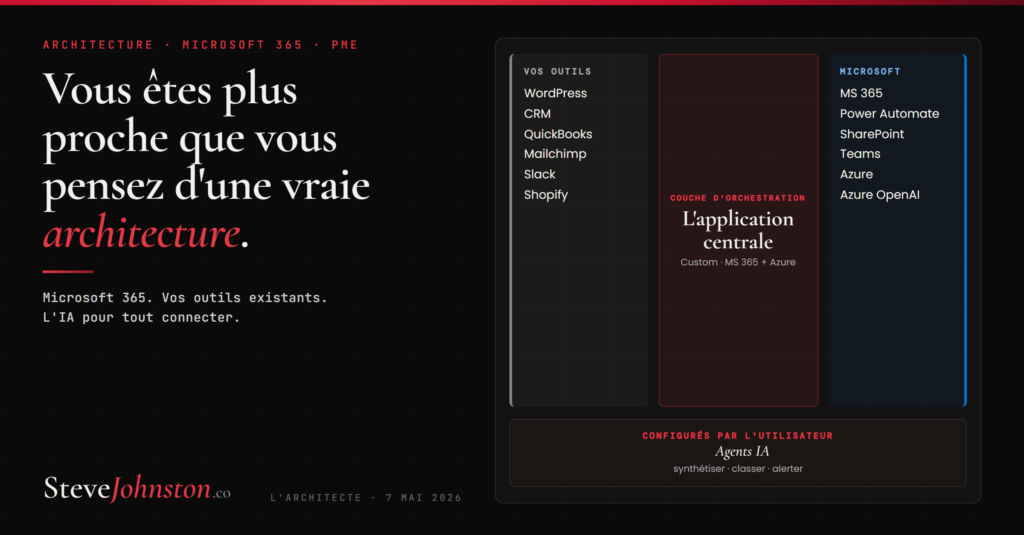
The Center: Your App
A custom application tailored to your operations, with the interface you want. Built on Microsoft 365 and Azure, which you already have.
This app centralizes everything. It tracks what’s happening in the organization, step by step, file by file. It stores data. It displays information. It decides what to show to whom.
The interface isn’t Power Apps or another low-code tool. It’s custom code, hosted on Azure, that delivers a truly customized interface: your colors, your logic, your terminology, your workflow. The user experience your teams deserve—not a generic low-code compromise.
Power Automate for workflows. SharePoint for documents. Azure for computing, storage, and AI. You probably already have access to all of these.
The application isn’t just some off-the-shelf SaaS solution you rent. It belongs to you. It reflects your business processes. It grows with you.
The Periphery: Your Existing Tools
Your tools stay where they are. WordPress continues to host your site. QuickBooks continues to handle your accounting. Your CRM, Mailchimp, Slack, Shopify, forms, and project management tool—all fully functional and seamlessly connected.
The central application communicates with everyone via APIs. It retrieves the necessary information and displays it in a single interface. No more duplicate data entry. No more Excel files to reconcile.
What does that look like in practice?
QuickBooks remains your accounting system, but the central application displays accounts receivable by customer in real time within the customer file. Mailchimp remains your email marketing tool, but the central application triggers campaigns based on the status of your workflow. Slack remains your communication channel, but the central application automatically sends relevant alerts to the appropriate channel.
Tools don't disappear. They become part of a cohesive whole.
Agents: user-configurable
At the bottom of the architecture, where users configure things themselves. AI agents for the repetitive tasks we assign to them. Synthesizing, classifying, alerting, and preparing reports.
The user remains in control. They tell the agent what to do and where to stop. As I wrote last week in the article on the “black box” of autonomous agents: logs, flags, validation. Governance is established before deployment, not after an incident.
With Azure OpenAI, Copilot Studio, and Azure Functions, setting up an agent used to take weeks of specialized work just a year ago. Today, it can be done in a matter of hours for a specific use case.

Why You're Closer Than You Think
The Microsoft 365 subscription you already have includes Power Apps, Power Automate, SharePoint, and Teams. Azure adds computing power, storage, and AI. APIs are available for most SaaS tools on the market.
The missing piece two years ago was the maturity of AI to generate code and accelerate design. That piece is now in place.
In practical terms, what used to take 6 to 12 months using traditional development methods can now be accomplished in just a few weeks. With tools like Claude Code, GitHub Copilot, and the native capabilities of the Power Platform, an architect can design, prototype, and deliver solutions much faster than before.
That’s what I confirmed when I tested it at home. And that’s what I now offer my clients.
A real-life example
I am currently working with an organization that supports entrepreneurs. It’s a team that works with several entrepreneurs at the same time.
The situation before. Multiple steps per contractor. Statistics that had to be compiled manually. A sense of the situation that needed to be captured during every interaction but got lost in scattered notes. Data spread across a dozen different tools. Year-end reporting kept the entire team busy for weeks because nothing was centralized.
What we’ve built. A central application built on Microsoft 365 and Azure. It tracks each entrepreneur’s journey, captures sentiment at every touchpoint, and aggregates statistics in real time. It connects to existing tools to retrieve information without requiring manual re-entry. Customizable agents help the team organize, summarize, and prepare reports.
What’s changing now. The organization now has an instant snapshot of its support portfolio. Annual reports are generated in just a few clicks instead of taking weeks of work. Decisions are made based on real data, not on assumptions.
Entrepreneurs feel the difference, too. The organization understands them better because it has a clearer picture.
Key takeaways
You have Microsoft 365. You probably have Azure or access to it. You have AI. You have your existing tools that work.
What’s missing to create a coherent architecture isn’t just another license.
This is the layer that brings everything together. An app at the center. Your tools on the periphery. Your agents wherever you choose.
And with what we have today in Microsoft 365, Azure, and AI, you’re closer than you think to being able to build it.
If you'd like to discuss this for your organization, here's my Calendly link to schedule a 30-minute meeting with me.
This article is excerpted from the May 7, 2026, issue of *L’Architecte*, Steve Johnston’s weekly newsletter on the digital transformation of small and medium-sized businesses.
To receive the weekly analysis on AI and digital transformation for SME leaders, sign up for L’Architecte.
