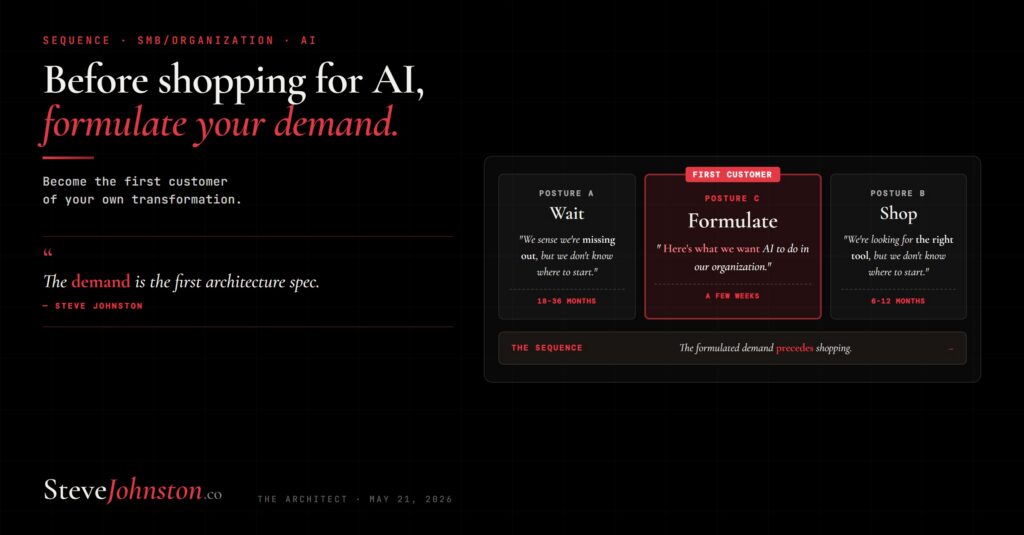
I have worked in AI, digital optimization for businesses, and technology for a long time. I did not think there was a demand problem.
True, I see a lot of uncertainty among leaders when it comes to AI. But in my mind, uncertainty was not the same as an absence of demand.
In May 2026, I changed my mind on that question. And I want to share the tactical move that I believe is the most useful for any SMB or organization that wants to do AI in 2026.
Sit down and document a process
The most useful move you can make quickly for your AI needs no budget, no licence and no vendor demo.
A pen. A sheet of paper. One hour of your time.
Pick one of your processes. Any of them. The one that irritates your front-line teams the most, or the one that eats your time in manual compiling. Write it out in sequence: step 1, step 2, step 3, all the way to the end.
No technology. No AI jargon. Just the operating logic as it actually plays out in your organization.
Then, one step at a time, ask yourself: how could AI replace or lighten this step? You will find more than one.
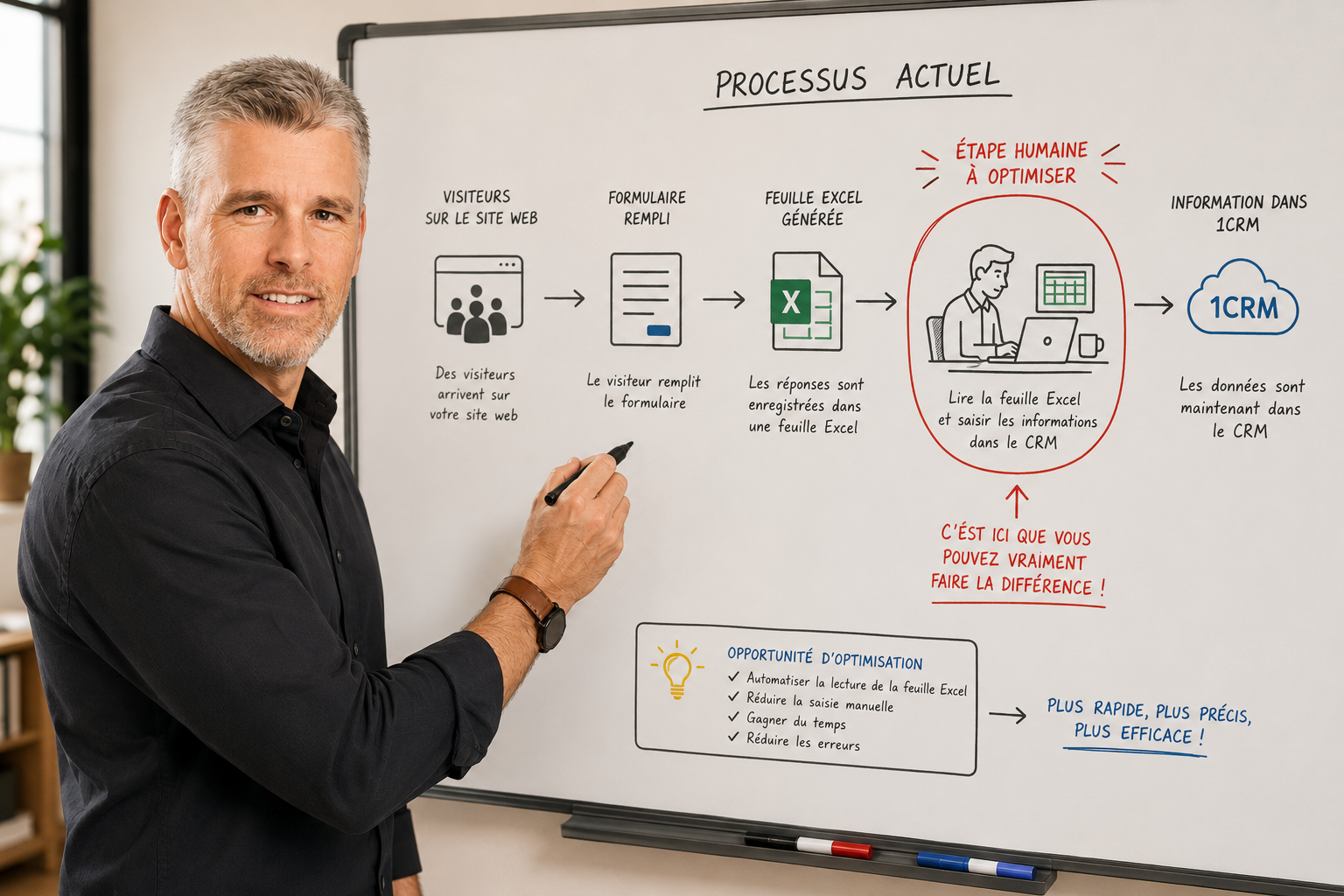
And if you prefer the assisted version: take your documented process, share it with an AI chatbot, and ask it to identify the optimization opportunities. It will list them for you.
That list is the beginning of your formulated demand.
Why this step changes everything
Look at how AI is advertised today and you mostly see chatbots. An interface, questions, answers. Useful, but that is not where the transformation happens for an SMB or organization.
Where AI really makes a difference is in the processes. How the organization tracks its files, catches its signals, produces its reports, makes its decisions.
And that is exactly where the demand never gets formulated.
AI in your processes is scary
An SMB or organization can test a chatbot with zero risk. If it does not work, you remove it and nobody is affected. But putting AI inside a process touches operations, teams, clients, members. It commits you. And that is exactly why the demand hesitates.
The reflex that costs you
Most leaders are still looking for the product that will be right for their organization. That is the reflex: shop, compare, choose among what exists. And they walk out with what the vendor had to sell. Not with what their organization needed.
The new paradigm
Today, you can think differently. What are my needs? My objectives? My way of working? Define the specifications. Create the product you want, rather than picking one off the shelf.
And at a fraction of what it used to cost. Not long ago, a custom platform cost hundreds of thousands of dollars. Months of development. Code written by hand, line by line. Reserved for large companies.
Today, it is within reach. Thanks to artificial intelligence, which speeds up development, rendering and iteration.
““Your demand is the first spec of the architecture.” (Steve Johnston)
What I saw in the field
In an earlier L’Architecte post, I wrote about the three Quebec provincial associations building a 70-30 hybrid architecture together. What I did not tell you is how they got there.
The context before
For years, each of them looked for a SaaS that would fit its mission. None did. The first waited about 18 months. The other two, close to 3 years. All that time, their front-line teams compiled by hand, their members got a service less fluid than it could have been, and each of the three leadership teams felt it was “missing the AI shift” without being able to name exactly what was missing.
They were consumers of supply. And the supply did not deliver.
What changed everything
The turning point: moving from “consumer of supply” mode to “formulator of demand” mode.
Instead of hunting for a SaaS, they wrote the spec of what they wanted. Not a technical requirements document with boxes to tick. A description of the operating logic they wanted supported. How their front-line teams worked. Which signals they wanted to catch in time. Which reports they wanted to generate in a few clicks instead of a few weeks.
Once that spec was clear, two things appeared. First, that together the three could afford what none could alone. Second, that together they could anonymously compare their readings of the same territory (Quebec’s 17 regions).
The result
The 70-30 hybrid architecture described in the previous post is not the starting point. It is the result.
The starting point was formulating a clear demand together.
And the waiting cost that came before (18 to 36 months depending on the association) shows exactly what we see in so many organizations. Canadian SMBs and organizations do not have an AI supply problem. Their problem is knowing what they want to order.
Macro validation: Arsenault’s diagnosis
In May 2026, a well-known venture capitalist named, at the national level, what I see in the field in SMBs and organizations.
On May 11, 2026, speaking at the Cercle canadien de Montréal, Chris Arsenault, founder and CEO of Inovia Capital, delivered a diagnosis that flips the usual debate on AI in Canada:
““Canada does not have a supply problem, it has a demand problem.”
The Canadian ecosystem already has strong supply. Cohere, Mila, Montreal’s talent pool, hundreds of startups. The technology exists, the talent is there. What is missing is on the buyer side.
His comparison with the United States hits home. In the U.S., government and large companies drive innovation, drive the economy, and show SMBs and organizations the way forward. In Canada, we tend to wait for demand to come from somewhere else.
What Arsenault describes at the macro level plays out as a perfect mirror in every SMB and organization. One at a time.
Source: La Presse, Richard Dufour, “Intelligence artificielle : Le Canada n’a pas un problème d’offre, mais un problème de demande” (in French), May 11, 2026.
The sequence in three steps
For an SMB or organization that is serious about doing AI in 2026:
Step 1: Formulate the demand. The move in this article. Sit down and document one of your processes. In a few minutes, an hour at most, you will spot where AI can help you. Or share your documentation with an AI chatbot and it will tell you itself how to optimize.
Step 2: Choose the dosage. Pure SaaS, a 70-30 hybrid, or custom (see the May 14 edition on organizational business intelligence). Once the demand is clear, choosing the dosage becomes easy.
Step 3: Find the partner who executes your demand. Not the one who sells you theirs.
Most SMBs and organizations skip step 1 and arrive at step 3 with nothing to ask for. They walk out with what the vendor had to sell.
Becoming the “first client” of your own transformation starts with step 1.
My own vantage point
I have sat on the board of the Axéo incubator in the Outaouais since 2017. I know the reality of startups. Connecting a startup with a large company unlocks innovative solutions. When the big player takes on its role as first client, it works.
What I see in the startup world, I see mirrored inside SMBs and organizations themselves. The breakthrough does not come from supply. It comes from clearly formulating a demand.
If you would like us to formulate your demand together, here is my Calendly link to book 30 minutes with me.
From the May 21, 2026 edition of L’Architecte, Steve Johnston’s French-language newsletter for SMBs and organizations that are serious about AI.
An editorial follow-up to the May 14, 2026 post on organizational business intelligence.
