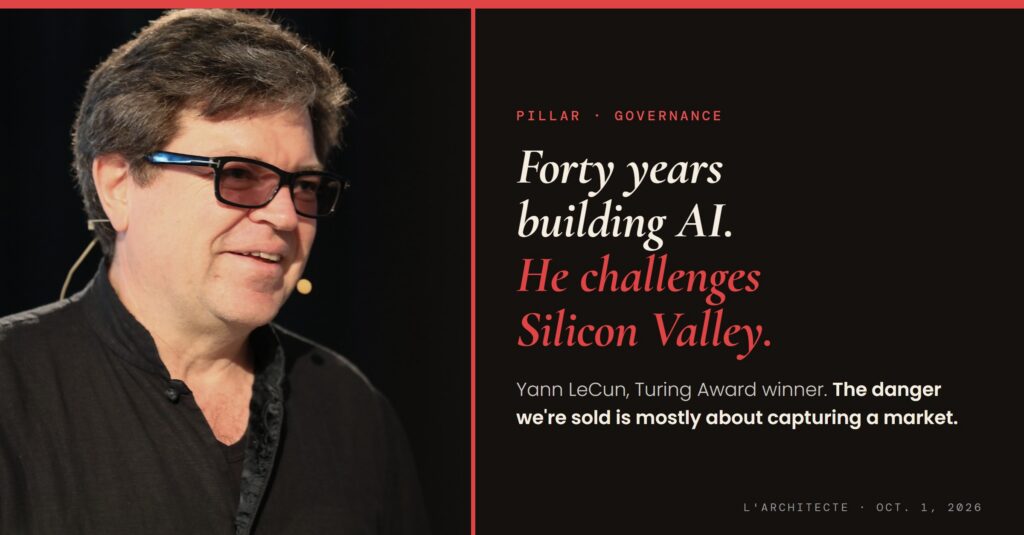
On September 16, Yann LeCun gave the opening lecture of the year at Sciences Po. An hour and a half, in front of an audience, in French, and it is online. I was genuinely glad to watch it, because it lined up with the way I see things. He knows far more about this than I do, obviously.
But in essence, he confirms that AI has a lot of gaps right now. That the AI that destroys us is a movie plot. And that we have plenty of time to put the safety guardrails properly in place, while deploying artificial intelligence to the fullest.
Here is what he said, and what it changes for an organization here at home.
Who is talking, and why it matters
Turing Award, the Nobel of computing. Forty years on neural networks. Twelve years leading AI research at Facebook, before leaving to found his own company, which has a foot in Montreal.
This is not someone looking at AI from the outside. He built it.
And what he came to say is that the danger everyone talks about mostly serves another purpose.
“but above all a desire to capture the market through regulation, by convincing governments around the world that AI is inherently dangerous.” Yann LeCun, at 14:24 (my translation)
He goes on to say it is false, and he spends the evening proving it.
What the machine still cannot do
His demonstration fits in one image. We now have systems that pass the bar exam, write essays and prove theorems. And yet not one whose understanding of the physical world comes close to a house cat’s. A cat needs no language at all to know how to jump from one roof to the next.
The reason is physical, and simpler than it sounds. To understand the world, you need touch, and touch does not exist yet. The best tactile sensors we have are soft gels coated in paint, with a camera reading them. Their precision is remarkable, and the paint wears off after a few hours of use. Until that problem is solved, he says, performance will probably plateau.
On vision, the gap is the same order of magnitude. A four-year-old has taken in as much information through their eyes as the largest model has taken in from all the public text on the internet.
So when someone brings up an artificial general intelligence arriving three years from now, he answers two things. The term itself is wrong, because human intelligence is not general but highly specialized. And the people announcing it are doing it for commercial reasons: give us 300 billion, is how he sums it up, before concluding that it is false.
The disaster scenarios, seen by the people who build the technology
On the end-of-the-world scenarios, he does not mince words. An AI that would take down chunks of the internet is, in his words and my translation, “a good plot for a James Bond film, but in reality it doesn’t work at all”. And the idea that an AI might one day hand someone the recipe for a virus capable of wiping out humanity has “biologists rolling on the floor laughing”, because the recipe already exists, and the hard part was never there: it is in the synthesis and the delivery, which take teams and machines that are rare and all monitored.
What does worry him is somewhere else.
“If these assistants are proprietary and produced by three or four companies on the west coast of the United States or in China, it’s not good for culture, it’s not good for democracy, it’s not good for values, it’s good for nothing. (…) So sovereignty is absolutely necessary, it’s not an option.” Yann LeCun, at 49:28 (my translation)
And he does not say this in a doomsday tone. He says the opposite.
“So we may have lost the LLM round in Europe, but we haven’t lost the AI battle, because there are going to be other revolutions and we can be at the start of that next revolution.” Yann LeCun, at 47:38 (my translation)
My read: an economic war, not a safety question
He is saying it for Europe. I hear it for us.
The limits he describes do not mean never. They mean not now. And the humanoid that destroys us, we are a long way from that.
My own read is that Silicon Valley is trying to slow down the competition, global and local alike, while it keeps moving very fast on its own side, fast enough to leave everyone behind. The goal is to win a technology war that has gone global, with enormous economic stakes, and it will play out over the next few decades. That is how it has to be read. Several tactics serve that strategy, and fear is one of them. That appears to be true.
I do not want to say more than he does, though. LeCun does not claim there is no risk. He says we should regulate uses rather than research, and that in most sectors the rules already exist. What he rules out is the machine escaping humanity, not ordinary caution.
Ethics and governance, we are aware of them and we are working on them, myself first. That is not what is blocking us. What is blocking us is fear, and because of that fear, kept alive here as much as anywhere, people hit the brakes.
We have been afraid before, and it cost us
Thirty years ago, we swore nobody would ever give a credit card number to a website. Today we pay for our coffee with our phone.
And when the automobile arrived in England, the law required a man to walk sixty yards ahead of every vehicle waving a red flag, and capped speed at four miles an hour in the country and two in town. The man with the flag walked ahead of the cars for thirteen years, and the speed limits held for thirty-one. If we had put that same energy into breeding better horses, would we have gotten as far?
Today it is AI. Aren’t we doing the same thing all over again? Aren’t we still afraid of progress, afraid of change?
I think it is wired into us.
The problem is that we cannot afford to hit the brakes. We are already behind on productivity, and that is not a feeling. In its 2025 report, the Centre for Productivity and Prosperity at HEC Montréal compared every Quebec industry to its American equivalent, using 2023 data. In 94% of Quebec’s economy, our industries produce less per job than their American counterparts.
The same report adds that our gap with Ontario has narrowed by 25%, and it warns right away that this is a mirage: Ontario is falling back faster than we are, we are not moving forward. Our neighbours are not pulling ahead of us. We are being left behind together, by the rest of the world.
So I sincerely believe that for our productivity and our economic performance, we have to push on AI, always inside a solid safety framework, but push. Because otherwise we are the ones who get left behind, and our economy pays for it.
What I did on my own QuickBooks
I am building productivity software, and I test on my own business first. Lately, I hooked AI up to my QuickBooks.
The very first thing I wrote, before I even looked at what the tool could do, was a prohibition: you cannot send anything.
For everything else, I opened it all up. It reads the whole file, it prepares my invoices, and it never sends them. That part I do by hand. It is not an instruction I repeat, it became a permanent rule of the tool, because sending commits you. It carries my name, and if it is wrong, I am the one who answers for it.
Writing that one line is what made me ask the question about a profession like accounting, one of the most tightly regulated there is, with its professional order and obligations that leave no room for approximation. Could AI replace it?
What I pay my accountant for is not data entry. It is the signature at the bottom of the return, the judgment call on a case that is not clear, and someone who defends me if Revenu Québec knocks on the door. That is exactly the part I refused to hand to a machine.
On my side, the rule gave me both at once: I move faster on preparation, and I stand on firmer ground on what I sign. A regulated profession has the same door open, with the same guardrails. The machine reads and prepares, the signature stays with a person who answers for it in their own name.
Refusing to let something leave your hands is not dragging your feet. It is judgment.
Where to start this week
Write your rule before you plug anything in.
That is the move for this week, and it takes ten minutes. Take a task you already do, and before you even ask whether AI can help, write down what it will never be allowed to do. Send a proposal. Talk to a client. Approve an amount. Publish anything. Pick your line, and write it down.
The rest of the task, you can open wide. Reading, sorting, preparing, summarizing, drafting a first version: that is the ground where the machine is strong today, and it is much bigger than people think. That is not where the science is stuck, and that is not where your risk sits.
Your risk is the moment something leaves your shop with your name on it. So protect that moment, and move forward everywhere else.
I have done this dozens of times now. And never, not once, has AI done something I did not want, as long as the blocking statements were clear and they blocked the right thing.
Sources
- Talk “Yann Le Cun : où va l’intelligence artificielle ?” (Yann Le Cun: where is artificial intelligence going?), Sciences Po, streamed live on September 16, 2026, 1 hour 28 minutes: the talk on YouTube. The quotes are transcribed from the audio and translated from the French by me, and every link in the text leads to the exact passage.
- “Productivité et prospérité au Québec, Bilan, édition 2025” (Productivity and prosperity in Quebec, 2025 report), 15th edition, Centre for Productivity and Prosperity, Walter J. Somers Foundation, HEC Montréal. Jonathan Deslauriers, Robert Gagné and Jonathan Paré: the 2025 report in PDF.
- Locomotive Act 1865 in the United Kingdom, known as the Red Flag Act, and its repeal in 1896: the Locomotive Acts page.
