
ERP in SMEs: it's not the system, it's the way work is organized
In many SMEs, when an ERP system is introduced, we hear the same phrase: "The ERP is causing us problems." The reality is often simpler. An ERP system is consistent. It does exactly what it was configured to do. When it breaks down, it's not always because the tool is bad. It's because it highlights a work organization that was not standardized.

1) What ERP does very well (and why that's a problem)
An ERP is a consistency machine. It imposes fields, sequences, rules, and logic. When it is well configured, it becomes predictable. And that is precisely what hurts in an SME where everyone has their own way of doing things.
The myth: "We configure the ERP, and it will take care of everything."
This myth leads to rapid disappointment. When the ERP doesn't "do everything," we blame the system. Then we blame the people. And the team starts pointing fingers at each other.
Key takeaways
- The ERP has no intention.
- He has no "weapons."
- He does what he is asked to do, according to the rules that have been set.
2) The real problem: the work architecture
When data is consistent in the system but not in real life, the system reveals the discrepancy. Exceptions, workarounds, and habits start to appear. This isn't because employees are "against" the ERP. Often, it's because daily work hasn't been aligned with the tools.
Typical symptoms in SMEs
- Data re-entry
- Excel files “on the side”
- Calculations made elsewhere, then copied into the ERP system
- Superficial adoption: entering the minimum "just to say it's done."
3) Why Excel always comes back (shadow systems)
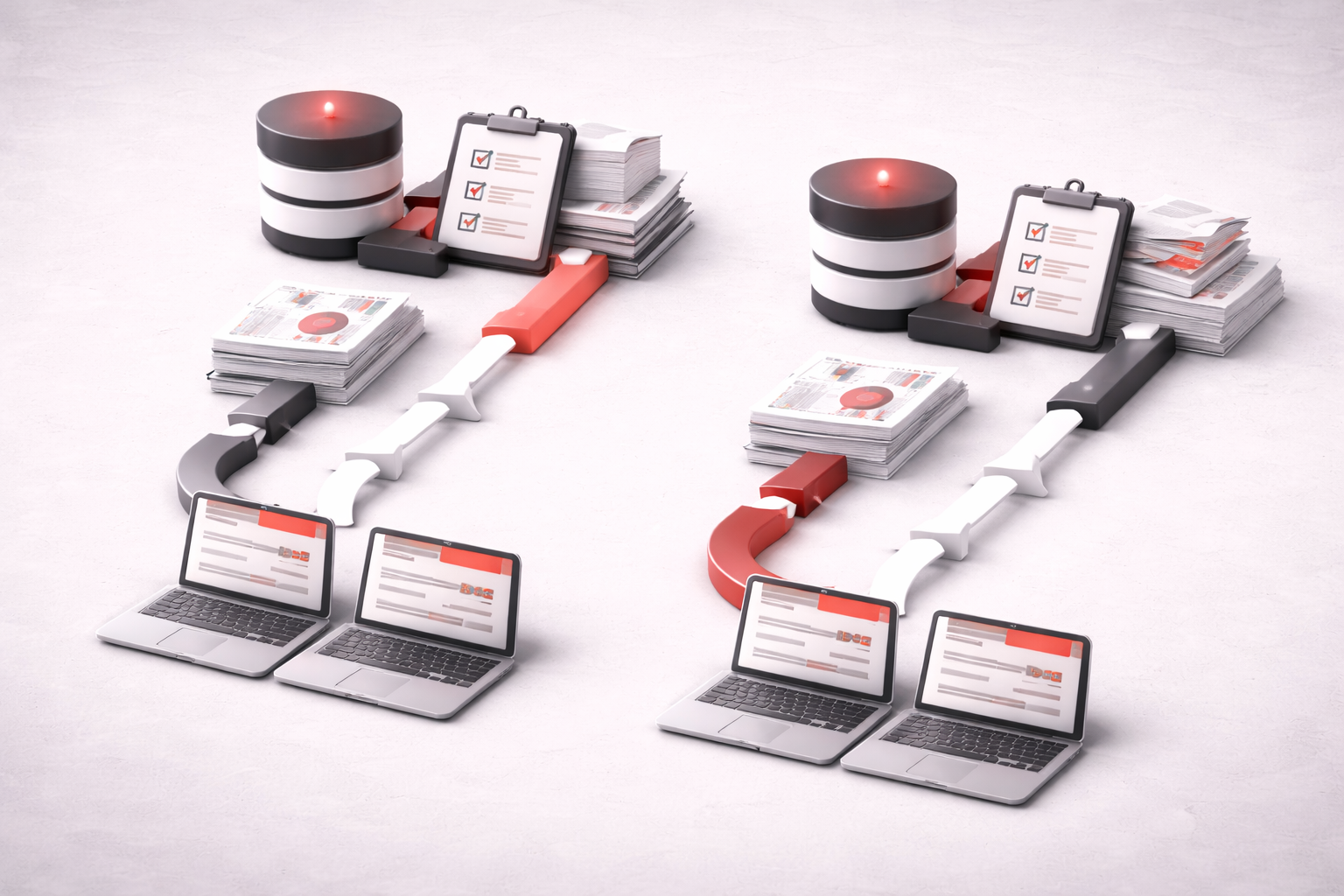
When someone feels that ERP isn't keeping pace with them, or that the steps aren't clear, they will create their own shortcut. It might be a "little Excel spreadsheet." Then two. Then three. And slowly, a parallel system is born.
The problem isn't Excel itself. The problem is what it indicates: a lack of clear sequence, or a lack of shared rules.
What these parallel systems really cost
- Re-entry= wasted time
- Multiple versions= inconsistency
- Exceptions= errors
- Decisions based on weak data
4) Preparation that makes all the difference: mapping + standard
Before "entering information" into an ERP system, there is some preliminary work to be done. This is where many projects fail.
The minimum viable requirement in terms of work organization:
- Clarify the work sequence
- Define who does what
- Define the rules (and what is an exception)
- Deciding which data is the source of truth
Mini checklist (field) before blaming the ERP
- Does everyone follow the same sequence for the same task?
- Are the rules written down, simple, and shared?
- Is there a re-entry?
- Is there a "parallel" Excel?
- Is daily work truly aligned with the ERP?

5) ERP does not create the problem: it exposes it.
An ERP system enforces consistency. And this consistency reveals: the absence of standards, the absence of clear sequences, the absence of shared rules, and the lack of coordination.
In other words: it's not a technological problem. It's a problem with the work structure.
Conclusion
- An ERP system is consistent: it executes what has been configured.
- When there is friction, the problem is often related to sequence, rules, behaviors, or adoption.
- The biggest leverage is upstream: mapping, standards, source of truth, data governance.
Frequently Asked Questions
Why is my ERP system causing problems?
Often, it does not cause them. It makes them visible by imposing a consistency that exposes non-standardized processes.
What is a shadow system?
It is a tool or method (often Excel) used "alongside" the ERP to bypass steps, because the actual work is not aligned with the system.
How can data re-entry be reduced?
By clarifying the source of truth, simplifying the sequence, and ensuring that data is entered only once, in the right place.
What improves ERP adoption?
Connecting ERP to daily work, standardizing rules, and reducing exceptions. Training helps, but process-tool alignment is crucial.
Is process mapping mandatory?
Not over 200 pages. But a simple map (what does what, in what order, with what rules) completely changes the quality of an implementation.
