If you want to talk it through for your organization, here is my Calendly link to book 30 minutes.
Most of the SMBs I meet already have Microsoft 365. Often for years. Often underused.
Around it, they have piled up other tools. A WordPress site for the storefront. A CRM for contacts. QuickBooks for the books. Mailchimp for email. Slack or Teams for communication. Sometimes Shopify for the online store. A project management tool somewhere.
Each tool does its job in its own corner. Fine.
But the information does not move between them. Teams key in the same data twice. Nobody holds the full picture. And when a decision has to be made with real data, someone spends three days compiling Excel files.
That is the most common gap I see. Not a shortage of tools. A shortage of connection between them.
What I have been telling leaders since spring 2026
Here is what I found after testing it at home, in my own company: you are much closer than you think to building an architecture that holds together.
Not with one more SaaS. Not by replacing what already works. By adding a layer on top that orchestrates.
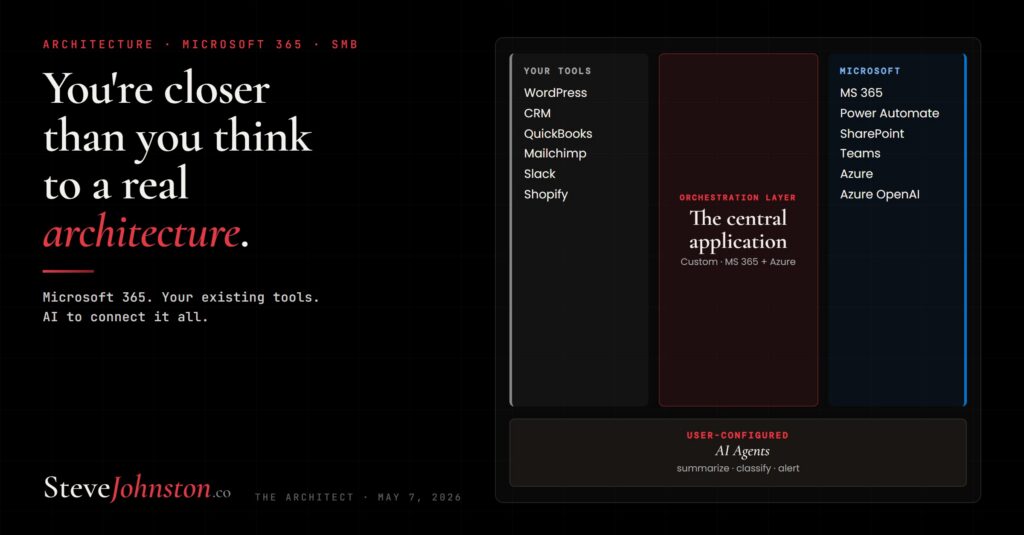
The centre: your application
A custom application, shaped to your operations, with the interface you want. Built on the Microsoft 365 and Azure you already have.
This application centralizes. It tracks what happens across the organization, step by step, file by file. It stores. It displays. It decides what to show to whom.
The interface is not Power Apps or another low-code tool. It is dedicated code, hosted on Azure, that produces a real custom interface: your colours, your logic, your vocabulary, your workflow. The user experience your teams deserve, not a generic low-code compromise.
Power Automate for the flows. SharePoint for the documents. Azure for computing, storage and AI. You probably already have access to all of it.
The application is not a SaaS black box you rent. It belongs to you. It reflects your operating logic. It evolves with you.
The edges: your existing tools
Your tools stay where they are. WordPress keeps hosting your site. QuickBooks remains your accounting system. Your CRM, your Mailchimp, your Slack, your Shopify, your forms, your project management tool. All working. All connected.
The central application talks to each one through its API. It pulls the useful information and displays it in a single interface. No more double entry. No more Excel files to reconcile.
In practice, what does that look like?
QuickBooks stays your accounting system, but the central application shows each client’s receivables in real time, right in the client file. Mailchimp stays your sending tool, but the central application triggers campaigns based on the statuses in your process. Slack stays your communication channel, but the central application automatically sends the relevant alerts to the right channel.
The tools do not disappear. They become contributors to a whole that holds together.
The agents: configured by the user
At the bottom of the architecture, where users configure things themselves. AI agents for the repetitive tasks you define for them. Summarize, classify, alert, prepare a report.
The user stays in control. They tell the agent what to do and where to stop. As I explored in an earlier post on the black box of autonomous agents: log, flags, validation. Governance goes in before deployment, not after the incident.
With Azure OpenAI, Copilot Studio and Azure Functions, configuring an agent still took weeks of specialized work in 2024-2025. Today, it takes a few hours for a defined use case.
Why you are closer than you think
The Microsoft 365 you already have includes Power Apps, Power Automate, SharePoint and Teams. Azure adds computing capacity, storage and AI. APIs exist for most of the SaaS tools on the market.
The piece that was missing before 2024-2025 was AI mature enough to generate the code and speed up the design. That piece exists now.
In practice, what used to take 6 to 12 months of classic development now takes a few weeks. With tools like Claude Code, GitHub Copilot and the native capabilities of Power Platform, an architect can design, prototype and deliver much faster than before.
That is what I validated by testing it at home. And it is what I now offer my clients.
A real case
I am working with an organization that supports entrepreneurs. A team that follows the journeys of several entrepreneurs in parallel.
The context before. Several stages per entrepreneur. Statistics to compile by hand. The sentiment of each interaction, lost in scattered notes. Data spread across a dozen different tools. Year-end reporting tied up the whole team for weeks, because nothing was centralized.
What we built. A central application on Microsoft 365 and Azure. It follows each entrepreneur’s sequence, captures the sentiment at every point of contact, and aggregates the statistics in real time. It connects to the existing tools to fetch the information instead of asking anyone to re-enter it. Configurable agents help the team classify, summarize and prepare the reporting.
What changes now. The organization has a live picture of its whole support portfolio. Annual reporting takes a few clicks instead of weeks of work. Decisions get made on real data, not on what everyone assumes.
The entrepreneurs feel the difference too. The organization understands them better because it sees better.
What to remember
You have Microsoft 365. You most likely have Azure, or access to it. You have AI. You have existing tools that already work.
What is missing for an architecture that holds together is not one more licence.
It is the layer that orchestrates. One application at the centre. Your tools at the edges. Your agents where you decide.
And with what Microsoft 365, Azure and AI put on the table today, you are closer than you think to building it.
If you want to talk it through for your organization, here is my Calendly link to book 30 minutes with me.
This article is taken from the May 7, 2026 edition of L’Architecte, Steve Johnston’s weekly French-language newsletter on digital transformation for SMBs.
To get the weekly analysis on AI and digital transformation for SMB leaders, subscribe to L’Architecte.
