My two children will be juniors before long.
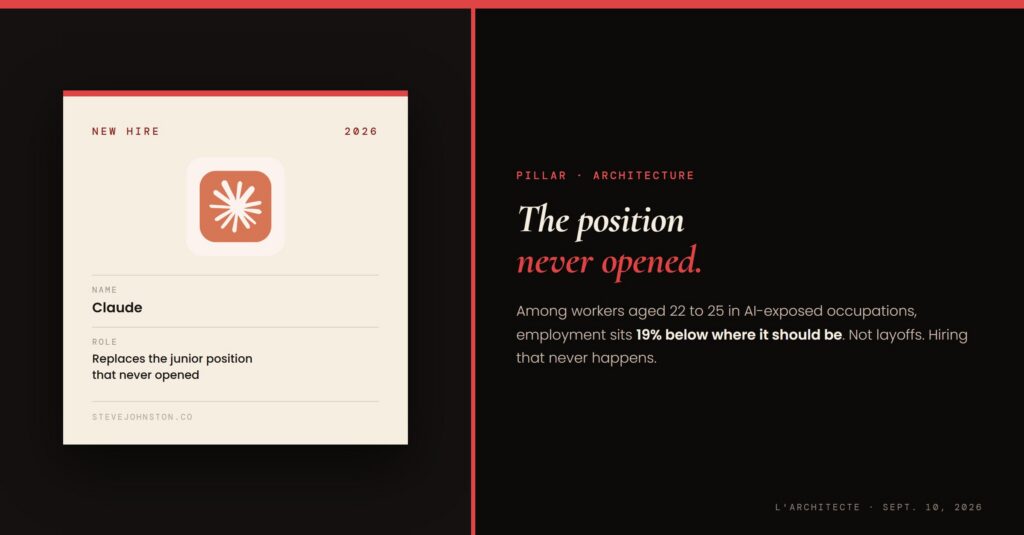
That’s probably why one Stanford study stayed with me longer than the others this year. Among workers aged 22 to 25 in the most AI-exposed occupations, employment sits 19% below where it should be. When it’s your own children walking up to that door, it stops being a statistic.
And that’s exactly why it’s urgent. I’m not waiting until they’re out of school to get started.
Three researchers went and read payroll records
Instead of surveying executives about their intentions, Erik Brynjolfsson, Bharat Chandar and Ruyu Chen went to look at what actually happens in payroll. Payroll from ADP, which pays more than 26 million American workers, through June 2026.
Their finding: among workers aged 22 to 25 in the most AI-exposed occupations, employment sits 19% below the trajectory of their peers in less exposed occupations. Experienced workers in those same occupations show no such gap. And the gap has been widening steadily since they first documented it a year ago.
Two details matter more than the number.
The first: this isn’t a wave of layoffs. The researchers find no trace of departures that would explain the gap. It widens through hiring that doesn’t happen. So there was no meeting, no decision, no moment where someone made the call: the position just stops opening, that’s all.
The second: the dividing line isn’t the occupation, it’s the type of knowledge. The researchers separate codified knowledge, the kind written down in a manual, a course or a procedure, from tacit knowledge, the kind you pick up on the floor. That’s their hypothesis, and the data points that way: the first one, the model already does. The second one, it doesn’t.
And codified knowledge is precisely what a junior brings on the Monday of their first week.
I plead guilty
Where this gets less comfortable is when I look at myself.
This year, the plan was to hire one or two juniors. I hired none. I hired Claude instead, and pushed token usage to the limit.
Then, when I needed human reinforcements on larger engagements, I didn’t go with a junior. I went higher: four to five years of experience, two of them working with AI.
Look at what that means. What I paid more for isn’t twenty years in the trade. It’s two years with a technology almost nobody used at work four years ago. The bar didn’t rise. It moved.
There was no dramatic decision in any of this. No moment where I sat down and said “no junior this year.” The position simply never opened. And from the inside, you can’t see it: it shows up nowhere in a budget.
I plead guilty.
That said, I don’t think my mistake was hiring Claude. It let me take on engagements I couldn’t have taken on otherwise. What I didn’t do was answer the other question: where are the senior people I’ll be working with five years from now going to come from?
And I honestly wonder how many of us have done exactly the same thing, without ever saying it out loud.
My angle goes further than that
A junior has to build their judgment and their own knowledge. The challenge is that if they trust AI blindly, they’ll never be able to guide it. And someone who can’t guide it eventually gets replaced.
But knowledge isn’t learned in a straight line. You pick it up from experienced people, from senior colleagues who have already seen the situation play out, from reading, and from fields that have nothing to do with your own.
I’m borrowing the term from others and stretching it a little: deliberate practice, but applied outside your career path rather than inside it. That’s what set me apart, and I think it’s truer now than it has ever been.
It’s my general knowledge, far more than my trade, that has always let me hold my own in a field I didn’t know at the start. And I learned, over time, by listening a lot.
Three possible places around an AI
Below it, it does your job and you’re gone.
Inside it, you do what it tells you: you copy, you paste, you send.
Above it, you see when it gets things wrong, and you’re the one who decides what to keep.
So a junior who wants to become a real asset has to stand out in their own way, and be able to stand above the AI. Not inside it, not below it.
That’s what I want to show my children. How to use AI in the best way possible, the most productive, the most ethical, and above all, how to become the kind of person others come to when they’re stuck.
No machine will do that for them.
What you can do this week
Just observe. Without announcing it, and without testing anyone.
One. Ask your usual questions about the work, and note who follows the AI without ever pushing back. Not to catch anyone out, but to know where your people stand.
Two. Place them, without judging. Those who follow without ever pushing back are inside it, or below it. That’s not a judgment on them, it’s a position. And a position can change.
Three. Find a way to move them up. Sit them next to someone experienced. Hand them a file in a field they don’t know yet. Ask them to tell you what looks off in the machine’s answer before they send it to you.
The day they control the AI instead of following it, your organization is the one that benefits. And it happens faster than you think.
Did you have a junior position in mind this year? Did it open? Write to me, I’m genuinely curious. I suspect I’m not the only one, and I’d like to know how it played out on your end.
Sources
- Erik Brynjolfsson, Bharat Chandar and Ruyu Chen, Canaries in the Coal Mine? Six Facts about the Recent Employment Effects of Artificial Intelligence, Stanford, August 2026 version. ADP payroll data through June 2026. Read the paper
- “Ce que les jeunes savent, les LLM savent déjà le faire” (“What young people know, LLMs can already do”), Les Numériques (in French), August 25, 2026. Read the article
