After several years of promises, consultations and delays, Ottawa has put something on the table. Not a final strategy, polished and exhaustive. A draft, with a direction, quantified ambitions and a budget orientation. And I think this draft deserves to exist.
This article builds on what I shared in L’Architecte, my newsletter, in June 2026. It opens up the context, the numbers, and the architect’s reading I give it for the SMB and organization leaders I work with.
What just happened
On June 1, 2026, CBC News obtained and published a draft of the federal document that shapes Canada’s new national artificial intelligence strategy. On June 2, Radio-Canada published an in-depth analysis of what the document contains. Ottawa’s official announcement follows within the week, carried by Minister Evan Solomon (Artificial Intelligence and Digital Innovation) under the Carney government.
To read the moment properly, you need the sequence. In 2017, Canada adopted a research-focused Pan-Canadian AI Strategy (CIFAR, Mila, Vector, Amii). Bill C-27 (which carried AIDA, the Artificial Intelligence and Data Act) then died on the order paper. Since then, the country had been waiting for an updated framework. That is what happened in June 2026, as a draft first, with the portfolio moved to Minister Solomon.
Several concrete figures come out of the document: 90,000 AI jobs by 2031, 1 million post-secondary students trained in AI literacy over the same period, $25M over six years for Statistics Canada to assess the impacts of AI, hundreds of millions added to the AI Compute Access Fund (currently $300M), a confirmed Canadian Tech Growth Fund, public support for 100 MW+ data centres, a public supercomputer, mandatory watermarking of AI-generated content, and a Canadian Artificial Intelligence Safety Institute.
Early analysts call the document “short on specifics.” A fair criticism. And, in my view, exactly the right level of precision for a subject that moves at the speed of AI.
The six pillars, read from the leader’s chair
The draft is built around six pillars. I name them here in terms that speak to an SMB or organization leader, not in press-release language.
- Protecting Canadians and democracy. Legal framework, privacy, online safety. In Quebec, this stacks on top of what you already did for Law 25.
- Empowering Canadians. AI literacy for 1 million post-secondary students by 2031. Your future talent pool, and a signal about AI culture in general.
- Supporting AI adoption in the private and public sectors. The pillar that hits leaders directly: support programs, self-assessment tools, an expanded AI Compute Access Fund.
- Building sovereign compute infrastructure. 100 MW+ data centres, a public supercomputer, projects like TELUS-Ottawa. It shapes cost, latency and sovereignty in the Canadian market.
- Growing Canadian AI companies. Canadian Tech Growth Fund, equity stakes. The capital pillar.
- Building international partnerships. Standards and alliances.
The average SMB or organization will mostly deal with pillars 1, 2 and 3. That is where operational decisions get made, in the short and medium term.
My angle: the courage to put a draft on the table
Plenty of commentators will stop at what is missing: no precise timeline, no eligibility criteria, no operational mechanics. That is easy to point at. I am taking the opposite angle.
Ottawa has put something forward. Not a final strategy: a draft, with a direction, quantified ambitions and a budget orientation. In our mandates, we call that a first version that deserves to exist.
In a field that changes as fast as AI, waiting for the perfect strategy before publishing it guarantees it will be obsolete on arrival. Minister Solomon keeps coming back to trust as the foundation. Trust is not built by waiting for perfection: it is built by shipping, explaining, adjusting out in the open, and showing that you are watching what happens.
It is exactly what I tell the SMB and organization leaders I work with. An imperfect AI usage policy, put forward and discussed with your team in a few days, beats a perfect one still being drafted six months from now, while your employees copy and paste into ChatGPT with no framework.
The Statistics Canada investment is the right signal
Of all the figures in the document, the one that stops me is the most modest on the surface: $25M over six years for Statistics Canada to assess the impacts of AI. Not a spectacular program, not a mega-investment like the hundreds of millions added to the AI Compute Access Fund.
It is better than that. It is an investment in the government’s business intelligence: gathering quality data to make better decisions, year after year. Not a political hunch, not an order from a minister’s office. Real data, measured and shared.
It is exactly the reflex of a serious architect, and what I recommend to every organization I work with. Before you optimize your processes, install digital tools and integrate AI, you need to gather quality data on your own operation. Without that base, you decide blind. With it, every adjustment rests on a picture your team actually shares.
Statistics Canada becomes that national sensor. You should have your own, at your scale.
What does an internal sensor look like for an SMB or organization? Not a six-figure business intelligence platform. More like a light mechanism to measure how much time your employees save (or lose) with their current AI uses, a simple log where each team notes what works and what jams, a quarterly review that looks at real usage data instead of impressions, and a few indicators on the quality of the data itself (duplicates, orphan files, missing metadata, folders with no owner).
It is not glamorous. It is what separates an organization that adjusts from one that guesses.
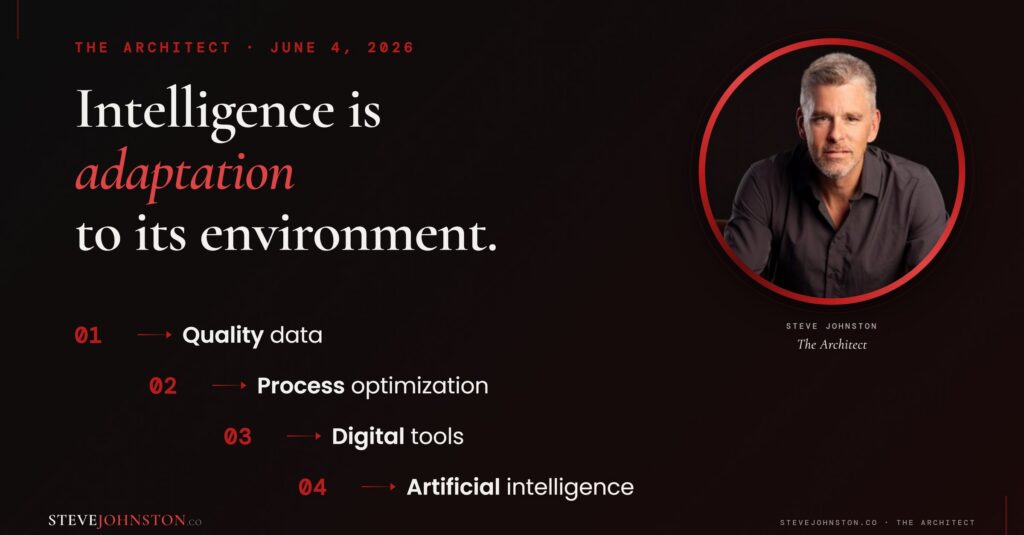
Intelligence is adaptation to its environment
Here is my core conviction, and I have held it for a long time.
Intelligence is not the absence of error. It is not perfect forecasting. It is the ability to adapt to your environment. An intelligent organization is not the one that planned for everything. It is the one that detects change, measures its effects, and adjusts before the cost of doing nothing outgrows the cost of adjusting.
That is true for an SMB that discovers its clients are using a new channel. It is true for an organization watching its employees adopt an AI tool on their own. It is true for a federal government trying to frame a technology that never stops changing.
Read this way, Carney’s draft is not a weakness. It is an act of collective intelligence. You start with what you have, you put the sensors in place, and you adjust between now and 2031.
In the field: the foundation before the tools
Recently, I was talking with the leadership of a large organization about a mandate we are starting together with StemJee: a full overhaul of their document management.
At a different scale, it is exactly what Ottawa is doing with its draft AI strategy. Lay a foundation. Build on it. Adjust as you go. The rest comes later. The federal draft did not plan everything out to 2031, and it could not have. The organization I am working with has not planned out its next five years either, and that is perfectly fine. In both cases, the condition for success is the same: start with the foundation, and accept that the rest will be written along the way.
No AI for now. No advanced tool. Just the patient work of defining the structure, fixing the naming conventions, categorizing the files and introducing metadata in a new way of thinking. The end of folders inside folders inside folders where nobody finds anything. The end of the `Report_final_v3_FINAL_reviewedPaul_OK.docx` file circulating in five versions.
Once that foundation is in place, everything else becomes possible: optimizing how work flows, choosing digital tools that actually mean something, generating clear reports without hunting for the right source all week, running AI on clean material instead of unsearchable chaos, managing permissions and compliance better, and watching employee performance climb because their environment is finally readable.
I have been running this kind of mandate regularly in organizations since 2018, with StemJee as the execution firm. It is the foundation, and it is what separates the organizations that succeed at digital transformation from the ones that keep stacking tools on soft ground.
The architect’s sequence, no detours
The sequence, in four moves:
- Quality data. You structure your information and settle your naming conventions. The thankless phase, and the non-negotiable one.
- Process optimization. With clean data, you can see the real flows, find the bottlenecks, and rethink the sequence of tasks before you drop a tool on top. This is the step most leaders want to skip, and it is precisely the one that makes the difference.
- Digital tools. Chosen to build on processes that are already optimized, not to replace them. A tool deployed on a chaotic process only amplifies the chaos.
- Artificial intelligence. On a healthy base, AI becomes a multiplier. Without the three floors beneath it, it hallucinates or stays a gadget.
At its own scale, Ottawa is following the same sequence: Statistics Canada (data), adoption support for SMBs (processes), the AI Compute Access Fund (tools), AI literacy and deployment (the AI layer). The order of operations is sound.
Ambitions with numbers beat fuzzy ambitions
90,000 AI jobs by 2031, 1 million students trained, $25M over six years for Statistics Canada, hundreds of millions added to the AI Compute Access Fund. None of these numbers will be hit with arithmetic precision. All of them set a direction. That is what a leader needs to make investment, training and hiring decisions: not a frozen truth, a compass pointing somewhere.
Do the same exercise in your SMB or organization. You do not need an 80-page roadmap. Give yourself three or four directional numbers over 36 months (hours saved through AI use, processes reviewed, people trained), write them down, and measure them every quarter. That beats an 80-page strategy nobody ever reopens.
What to remember
Three ideas to keep for the week ahead.
Waiting for perfect is the enemy of visible progress. Whether it is a federal strategy or the framework for your own SMB or organization, starting with something solid and adjusting continuously beats waiting for a perfect view. That is not a concession, it is applied intelligence.
Rigorous observation is an investment, not a cost. Ottawa’s move to fund Statistics Canada to track the impacts of AI is a governance move we should reproduce at the scale of our own organizations. How do you know whether your current AI uses save you time or cost you time? If you have no light mechanism to observe your own operation, that is where to begin.
Continuous adaptation is an organizational capability, not an event. It is not a one-time transformation you run and then finish. It is a muscle your organization trains. The framework gets sharper, the tools evolve, your teams adjust. By 2031, those who have built up six years of continuous adaptation will not be in the same position as those who spent six years waiting for a finalized national strategy.
Available resources
For a few months now, I have been gathering in one place the tools I share to help leaders start framing their digital practices and their use of AI. A resources page on my website brings it all together, whether the documents are hosted here or the tools are available through StemJee.
Available with no email required:
- One-page Starter Pack, a minimal AI governance framework in seven questions, to fill in with your team in one hour.
- 18-page Practical Guide, the in-depth version for organizations that want to go further on structure and compliance.
- FlowScan, an organizational optimization self-assessment quiz hosted through StemJee, built on the patterns observed across dozens of mandates in different industries. Its AI section is in step with the federal framework, on compliance and on nuance.
Everything is centralized on the resources page: stevejohnston.co/en/resources/. This page is kept up to date over the years, so check it for the latest releases.
Let’s talk
If you want to talk it through, structure your document foundation, or set up your own internal observation sensor, I would be very happy to discuss it with you: stevejohnston.co/en/contact-us/
Main sources: CBC News, June 1, 2026 (draft obtained); Radio-Canada, June 2, 2026 (in-depth analysis, in French); Lethbridge Herald / Canadian Press, June 2, 2026 (Minister Solomon quote).
