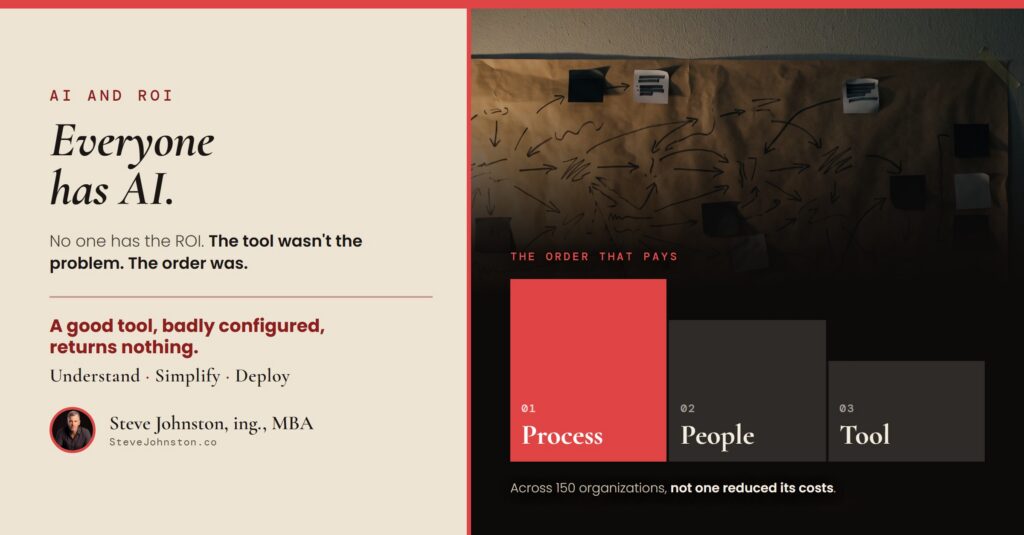
I see it, I say it again, and I keep saying it.
We go straight to the tool. That’s normal: it’s the most visible part, and it’s what everyone keeps showing us.
Before the tool, there’s what we do internally. Our processes. Especially the most important ones, the ones that bring in the revenue and the healthy profits, the ones the organization’s long-term health rests on. Those, you have to understand before going any further.
Then come the people. And only after that, the tool.
“What will the tool do for us?” isn’t the right question. “What do people need to do to make it work?” is part of it. The real question: do we understand our processes properly, well enough to optimize and improve them?
That’s where the return on investment is. Not in the tool.
Zero out of one hundred and fifty
A study released on August 17 puts a number on something many people feel but don’t dare say out loud.
Of 150 organizations that deployed artificial intelligence, not one reduced its costs. And two-thirds saw their operating costs go up.
The figure comes from TTEC Digital, published with the outlet CX Dive under the title The great CX reset. Two honest caveats before going further, because they change how far the number reaches.
First, the sample: 150 customer experience, contact centre and IT leaders. That’s one sector, not the whole economy. Second, TTEC sells customer experience transformation services. So the study comes from a firm that has an interest in the problem existing.
That doesn’t make the number wrong. It means we don’t generalize it, and I won’t.
What interests me more is the diagnosis. According to the study, the main cause is that organizations bolt cutting-edge AI onto an operating model designed before AI. Just one percent of the leaders surveyed describe their operating model as truly adaptive.
North of the border, we’re not watching from the sidelines. ESET measured this past April that 69% of Canadian SMBs already integrate AI applications, compared with 81% in the United States. Adoption is done. That’s no longer the question.
It isn’t your data’s fault
The reflex, faced with these numbers, is to say the data is dirty. You hear it everywhere, and it often comes bundled with the solution.
Except the study says the opposite. Only 15% of respondents cite unreliable data. Data quality has improved. It’s no longer the main bottleneck.
The blocker is elsewhere, and it’s far more down to earth.
60% of organizations run seven or more separate platforms. And only 43% are confident they know where AI is actually being used in-house.
In other words: we stacked tools on top of ways of working nobody ever mapped out, and we’re no longer quite sure who does what, with what. AI lands in the middle of that. It doesn’t tidy up. It accelerates.
This isn’t just one Quebec consultant’s opinion. BCG wrote the same thing in the spring, and I find their wording better than mine: acceleration without simplification backfires, because layering AI onto fragmented processes speeds up activity without eliminating low-value work, approvals or duplication.
Their conclusion fits in six words: remove unnecessary work before digitizing it.
My most common engagement
In several of my engagements, the job has been the same: take over a tool that had already been chosen.
The organization had bought. Often bought well, in fact. Then it didn’t deliver what had been promised, and they called me.
What I do in those cases never starts with the tool.
I start by mapping the existing processes, in detail. Who does what, when, and why. That last part matters most, and it’s the one most often skipped. When you ask why at every step, you regularly find that several steps exist for a reason that no longer does. A requirement from a former client. A control added after an error that was fixed long ago. A signature nobody reads anymore.
Then I redo the map, this time accounting for the tool, without distorting what already worked well internally. It’s an important nuance: the goal isn’t to bend the organization to the tool. It’s to keep the good process and make the tool follow it.
Then we configure the tool to follow that path.
And we train the staff, so it actually works.
In the end, it always comes back to the basics. Assess the process, improve it, and only then adapt it to the people and the tool.
Training isn’t a checkbox
On that last point, the TTEC study says something very telling.
90% of leaders say they’re confident in their ability to deploy AI. And not a single one, zero percent, says they have no internal skills gaps.
We’re confident about installing, and we know we’re not ready to use it. Oof.
That’s exactly the gap training closes, and it’s why training comes before the tool in the order, not after rollout as a ninety-minute catch-up session.
Wrong order or wrong choice
Here’s the distinction that matters most, and it’s the good news in this piece.
In those engagements, the tool is almost always a good tool. It’s badly configured, badly used, and it returns nothing. That can be fixed. It’s work, it takes serious mapping and training, but the investment isn’t lost.
When the tool itself was the wrong choice, going back is far more brutal. You don’t reconfigure, you start over. Migration, data conversion, full relearning, and often a contract to honour to the end for software you’ll no longer use.
That’s the whole difference between a wrong order and a wrong choice. The first can be corrected. The second gets paid for.
And that’s exactly why sequence matters before the purchase: it doesn’t only help you configure better, it keeps you from choosing the wrong tool.
Where to start, in practice
If your costs have gone up since you added AI, you didn’t make some exotic mistake. You did what nearly everyone did, and the numbers confirm it.
Three things, in order.
One. Take your most important processes. Not all of them. The ones that actually bring in money, the ones the organization’s long-term health rests on. Map them out and ask why at every step.
Two. Remove what no longer serves a purpose, before digitizing anything. That’s the step people skip, and it’s the one that pays. Digitizing a useless step means paying to keep it.
Three. Look at your people. What they know how to do, what they’ll have to do differently, and what they need to be shown before the tool arrives.
The tool comes after. And then it has a real chance of paying off.
If you’ve already bought, it isn’t lost. Most of the time, the tool is fine and it’s the sequence that was missing. You can get it back on track.
Sources
- TTEC Digital and CX Dive, The great CX reset: Why outdated operating models are stalling AI’s payoff, August 17, 2026. Survey of 150 customer experience, contact centre and IT leaders. News release · Report
- ESET, SMB Cyber Readiness Index 2026, April 16, 2026. News release
- Boston Consulting Group, Making AI Productivity Pay Off, 2026. Article
