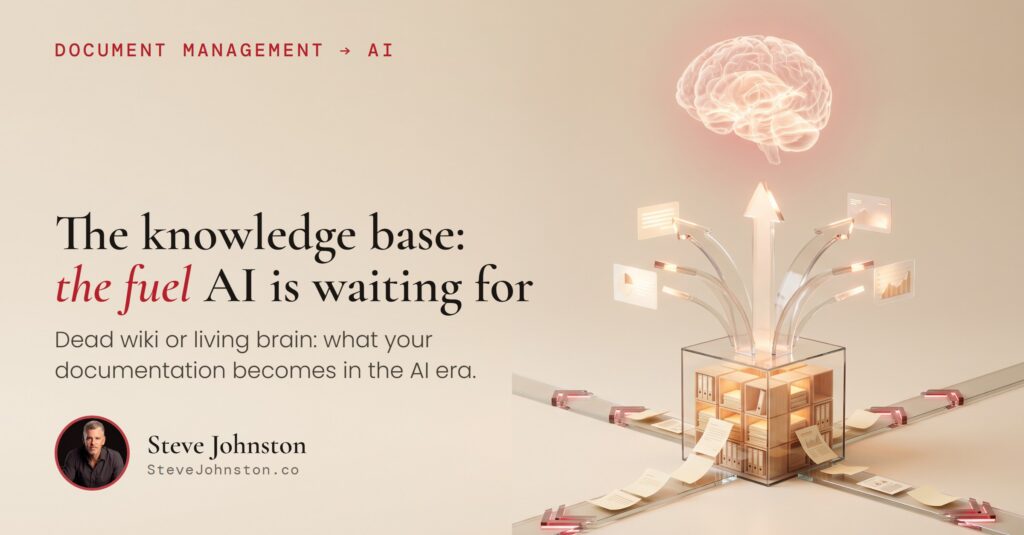
Those who follow me know it: I capture everything. My morning notes, my meeting debriefs, ideas dictated in the car between two appointments. For months now, all of it has been converging in one place, and I work that material with AI.
It has become my personal knowledge base. And honestly, the results still surprise me.
In this article, I want to show you what the term “knowledge base” really means in the AI era. Not the encyclopedia definition. The field version: what it changes for an SMB or organization, why it matters exponentially more than before, and where it starts.
The loop that changed how I work
Here is how it works for me, with no magic software involved.
Everything I capture converges in one place: documents, meetings, voice recordings, morning notes. Then I work that material with AI. I categorize it. I deepen it. I push it further. And once it is organized, I go back to it for inspiration and to keep going.
The loop looks like this:
- Capture: everything that has value, whatever the format.
- Centralize: one single place where the material converges.
- Categorize: with AI, every item finds its place.
- Deepen: still with AI, I cross-reference, question, develop.
- Reuse: I come back for inspiration, and the loop starts again.
The results are incredible. This base has become enormous, for my current projects and for future ones. Nothing gets lost, everything compounds. And the bigger it grows, the more productive AI makes me.
I have always recommended this to organizations. But in the AI era, the payoff has just changed scale.
An autonomy tool first
I have always been a fan of knowledge bases. Not as a documentation project: as an autonomy tool.
A well-built base lets every employee train themselves, find their own information and self-educate at three levels:
- Their role: how things are done, the templates, the past decisions that inform their own.
- The tech: the organization’s tools, how we use them here, not in theory.
- The market: the clients, competitors and trends the organization has already observed.
And while each person learns, something else happens, slowly but surely: the organization builds a corporate memory. Every meeting, every decision, every lesson accumulates instead of evaporating.
In the AI era, that memory changes status. AI never answers better than the knowledge you give it to read. A living knowledge base becomes exponentially more important than before, and the results you get from it are exponentially stronger and more relevant.
Your AI only knows what your organization took the trouble to retain.
What I see in the field
A nonprofit, about thirty people. It already has everything it needs: Microsoft 365 and its lineup of genuinely good tools.
What I saw there, I see in many organizations. The tools are underused, everyone knows that. But there is more: each of these tools produces its own format, and each employee has their own tool preferences, so their own format. A great handwritten or OneNote note, a solid Word document, a PDF, an Excel sheet full of incredible information. Everything exists. But everything is separate, and nothing is correlated.
This is a perfectly normal situation.
Imagine all of it amalgamated, converted into a language that is easy to understand and fast to access. You could ask your questions, generate your documents, your statistics, your reports. Real business intelligence, built from what you already own.
Because the goal is to thrive: a lasting, sustainable organization. Better revenue, better profits. Even if you are a nonprofit.
The raw material is already there. It just needs to be gathered.
Your knowledge base is part of your document management
This is the point that shifts the perspective: a knowledge base is not a separate project. It is part of your overall document management.
And that changes how you see document management. Because a well-filed document is good. A document that talks to you, that is the goal.
That is exactly what AI now makes possible, tirelessly. Every note, every meeting, every document becomes material you can query, cross-reference and put to work. You are no longer filing documents: you are cultivating a memory.
If you read my article on document chaos two weeks ago, you can see the logical next step. First, know where your documents live and in which tool. Then, turn that foundation into something that works for you.
Where to start
No need for a big project. The loop starts small, then feeds itself. The right questions to ask, in order:
- Where does it converge? One single place where the material accumulates. Not ten. One.
- What goes in? Your notes, your meetings, your working documents. What has value for tomorrow, not everything that exists.
- Who keeps it alive? Someone must own the structure. Not write everything: make sure the material is organized and usable.
- How does AI plug in? This is the step that turns an archive into a memory. AI categorizes, summarizes, cross-references, answers. You ask questions, it answers with your context.
You will notice the tool comes last. The sequence matters more than the technology: a knowledge base is an architecture decision first, not a purchase.
What about privacy?
A knowledge base concentrates what your organization knows, including information about your clients and your employees. Quebec’s Law 25 applies, and that is a good thing: it forces you to ask from day one what goes into the base, who accesses it, and where the data lives.
Now imagine you could do all of this, with each of your clients, your market, your operations, while complying with Law 25.
Well, here’s a scoop: I’m working on it. More on that soon.
What to remember
A knowledge base is no longer a documentation project: it is a memory that works. It is already being built, every day, in your organization: every note, every meeting, every document is part of it, whatever tool produced it.
What we do differently: we stop letting that material scatter. We pick one place where everything converges, we categorize with AI, and we let it grow.
And the day we ask our AI a question, it answers with our context: our clients, our market, our operations. Everything we have accumulated starts paying us back.
To get the weekly analysis on AI and digital transformation for SMB leaders, subscribe to L’Architecte (in French).
