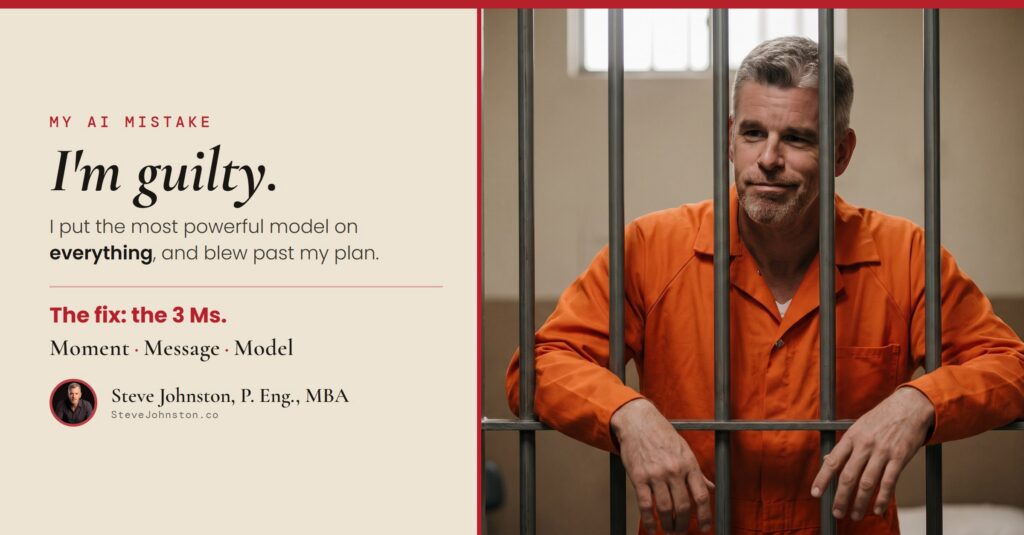
Let me start with a confession: I am guilty of exactly what this article calls out.
Fable came out. The new model, the most capable one. Like a lot of people, I jumped on it and put it on everything: my emails, my analyses, my drafts, every little task. The results were genuinely excellent, I will admit that.
Except Fable burns through a lot when you put it everywhere. Within days, I hit my limit, blew past my plan and paid for the overage. For tasks that, honestly, never needed that much power.
That mistake is how a method took shape, one I now use before every AI task. Three questions, always in the same order. I call them the 3 Ms. And don’t worry: wanting the best model is a normal reflex. It is fixable, and it is simple.
First, a quick word on what a model is
A quick word so we are on the same page: a model is the AI engine that does the work. Some are light and fast, others are big and powerful, and often the same tool lets you choose which one to use. Fable is a big engine.
It is easy to forget, because most consumer apps choose the engine for you. You type, it answers, you see none of the mechanics. But as soon as you start building something serious with AI, that choice comes to the surface. And it matters.
I am living it right now. I am developing a client management application, designed AI-first, with productivity and data sovereignty as its foundations. When a tool runs at scale, every function repeats thousands of times, and the engine I put behind each one ends up weighing on performance and on the bill. A simple task, a delicate task, a task repeated thousands of times: those are not the same needs.
The 3 Ms, in order
My method comes down to three questions, always in the same order. I call them the 3 Ms.
Moment. When do I need the answer, and how long does the task take to run? Answering a client who is waiting on the line is right now. Preparing a month-end review can run overnight, while I sleep. The moment decides whether I need speed or can let the work run at its own pace.
Message. Is my prompt clear and grounded in context? Instead of “prepare a presentation,” I say for which audience, for what goal, with what key message. Same engine, completely different result. Of the three, this is the question that pays off the most, and I come back to it further down.
Model. How much power does the task actually require? Rewording a note, a light engine is plenty. Analyzing a contract in depth, that calls for power. The real question is not “what is the best model?” It is “what is the right model for what I have to do?”
The secret is not the list. It is the order.
The reflex is to start from the model and take the most powerful one to be safe. That is exactly what I did with Fable. Now I keep it for last. Because most tasks do not need the most powerful one. Pulling it out for everything is like grabbing a sledgehammer to swat a fly: it works, but it costs a lot for nothing.
When I settle the Moment and the Message first, the third question becomes almost obvious. The task has already told me what it needs.
Price is not one of the three
You may have noticed that price appears nowhere in my three questions. That is not an oversight. Get your 3 Ms right, and the bill follows on its own. Price is not a setting. It is a consequence.
You will tell me: I pay a flat plan, so why bother? True, for normal use the big model does not change the bill much. But a plan has a ceiling, and my story proves it: put the biggest engine on everything and you hit that ceiling fast. Then you pay the overage.
It gets even more direct the day you build a tool that runs on credits. Every task consumes what are called tokens, and every token is billed. A task repeated thousands of times ends up weighing heavy. That is exactly where the 3 Ms pay off, and that is where I am right now, designing my application.
And one day it will be you adopting an AI tool sold on credits. At that point you no longer choose your engine: you inherit the one the designer put behind each function. Their discipline becomes your bill. So before you commit, ask them the question: did they think about those savings? Check.
Same method, three different answers
To make this concrete, let’s take three tasks everyone knows and run them through the same filter.
Summarizing emails. Building an important proposal. Sorting thousands of records.
The same three questions every time, but three answers that have nothing in common.
| The 3 Ms | Summarizing emails | Building an important proposal | Sorting thousands of records |
|---|---|---|---|
| Moment | Right now | A few minutes, no rush | Overnight, in batches |
| Message | A template I reuse | Lots of context, with examples | One prompt tested once, applied thousands of times |
| Model | Mid-range is plenty | The most powerful one, no hesitation | The lightest one that holds up |
Look at the last row. The most powerful model earns its place only one time out of three. The rest of the time, a more modest model does the job just fine, because the first two questions did the work before it. It is not the model that gets you out of trouble. It is the care you put into the Moment and the Message.
A filter before the three: data sovereignty
There is one point I deliberately keep separate, because it is not a fourth M. It is a filter, and it comes upstream.
Before you even choose a model, there is one question to ask: should this data leave at all? For some of it, I choose no, period. Your clients’ information, your sensitive files, everything Quebec’s Law 25 protects. It is not a slider you adjust. It is a line I would rather not cross.
And here is where the 3 Ms and sovereignty meet, rather nicely. Since we do not always need the most powerful model, we can often pick a model from here or from Europe, less advanced but more than capable enough for the task. Those models can run in Quebec, where your data should already be kept.
The result: nothing travels outside, and you do not depend on what gets decided south of the border. The discipline that saves you money is the same one that keeps you in control of your data. That is no coincidence. It is the same hygiene.
What to take away
There is no race to win. There will always be a newer model next week, and that is not where the difference is made.
A good prompt on yesterday’s model beats a sloppy prompt on today’s model, every time. The Moment tells you whether you need speed. The Message does the heavy lifting. The Model gets chosen last, once the first two have spoken.
And of the three Ms, the only one that costs nothing is exactly the one we neglect the most.
A challenge for this week. Take one task you repeat often, run it through the 3 Ms, and see what changes. You will likely find it needed less power than you thought. For me, it kept me from repeating the Fable mistake.
To get the weekly analysis on AI and digital transformation for SMB leaders, subscribe to L’Architecte (in French).
