Article content
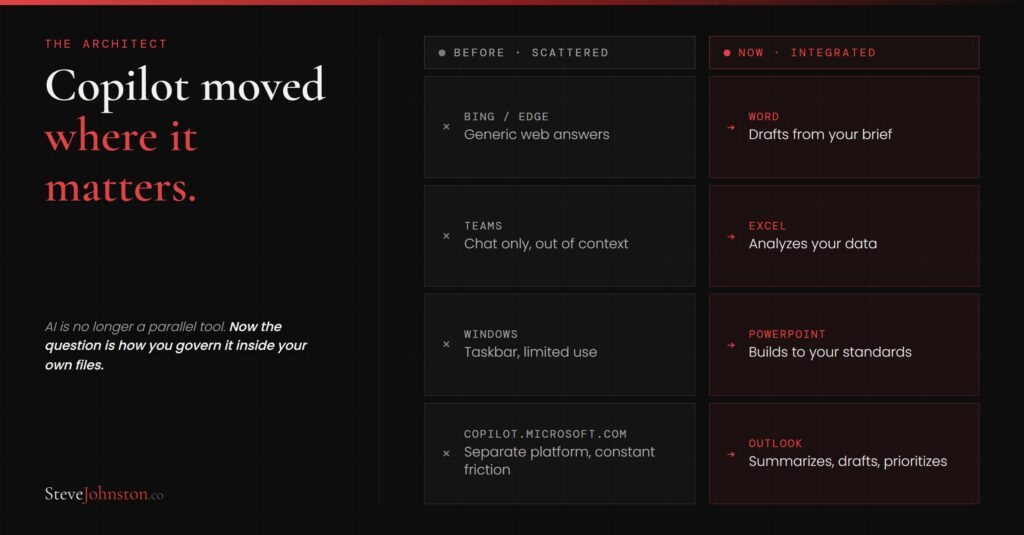
For two years, Microsoft Copilot was everywhere on paper and nowhere in real workflows. Bing, Teams, Windows, a separate platform at copilot.microsoft.com. Six different entry points for a tool that was supposed to make everyday work simpler.
The result on the ground: teams that didn’t use it. Not out of resistance. Because the tool wasn’t where the work got done.
Wave 3 changes the underlying structure.
What actually changed with Wave 3
The Copilot agent now works inside the four tools where most SMB teams spend their day:
Word. Copilot drafts a first version from a brief, summarizes long documents, and rewrites to a given tone. It works in the file, not beside it.
Excel. It analyzes the data you already have, generates formulas, and spots trends. You describe what you are looking for in plain language, and Copilot does it.
PowerPoint. It builds a deck from a reference document, respecting the templates and visual standards already in place.
Outlook. It summarizes long email threads, drafts replies, and prioritizes the inbox based on context.
The difference from earlier versions: Copilot is no longer a parallel platform you open on the side. It is in the flow, at the moment the decision gets made.
For Microsoft 365 users, that means AI is now inside their files, their data, their exchanges. Not beside them.
Why the earlier versions didn’t work
It is not a technology question. The language model behind Copilot was competitive. The problem was the integration.
I have tested Copilot regularly since it launched, for my own mandates and for my clients’. What I saw: tools like Claude or ChatGPT delivered better results in the real work environment, not because Microsoft’s technology was behind, but because the point of integration was in the wrong place.
The available tool is not the usable tool.
What was missing: integration inside the decision flow, not beside it. That is what Wave 3 fixes.
The real question for an SMB on M365
If your infrastructure already runs on Microsoft 365, the question is no longer “which AI tool should we adopt.” That choice is basically made for you. Copilot is already in your environment.
The question is: what governance do you put in place now that AI is already in your files?
This is not a theoretical question. It is an immediate, operational one.
A few concrete examples of what that involves:
Access and permissions. Which files can Copilot read to build its answers? If your SharePoint rights are out of date, employees could get answers built from sensitive documents they were never meant to see.
Organizational memory. Copilot draws on what lives in your M365 tenant. If your documents are poorly structured, badly named and scattered, AI cannot get any value out of them. The quality of the output depends directly on the quality of the structural input.
Traceability of decisions. When a manager uses Copilot to draft a client reply or summarize a financial report, who is accountable for the content? Governance has to answer that before it becomes a problem.
Field training, not just technical training. Having Copilot in Word is not enough. Teams need to know how to frame an effective brief, when to trust the output and when to check it, and how to fold AI into existing processes without breaking the workflows that already work.
What I see in the field
In the SMBs I work with, the profile is often the same. The M365 infrastructure is in place. Copilot licences are already there or on the way. But adoption falls short of its potential, because the structure did not come before the rollout.
The tool is available. The structure to use it in a way that is repeatable, governed and profitable is not.
This is not a technology failure. It is an architecture problem.
The firms that will get the most out of Copilot Wave 3 are not the ones with the best technology. They are the ones that structured their environment before deploying: organized documents, up-to-date permissions, documented processes, clear roles in how AI gets used.
Govern before you tool. That is the order that produces lasting results.
Where to start
If your organization runs on M365 and you haven’t started thinking about this yet, here are three questions to ask right away:
- Who has access to what in SharePoint? A quick permissions audit often reveals a significant gap between what was intended and what is real. Copilot will use those permissions as they are, not as they should be.
- How good is your internal documentation? If your procedures, templates and strategic decisions are not documented and reachable in M365, Copilot has nothing to build on. AI amplifies what exists, it does not compensate for what is missing.
- Who on your team is ready to pilot the adoption? Not a pure IT profile, not a generalist. Someone who understands the business workflows and can bridge what the tool can do with what the teams actually need.
The real decision
Microsoft Copilot Wave 3 is a successful integration. For SMBs and organizations already on M365, it is a major leap in bringing AI into the everyday work environment.
But technical integration is not enough. The tool is there. The governance work is still ahead for most organizations.
What separates an SMB that gets real value from Copilot from one that pays for licences with no results is not the technology. It is the structure put in place before deployment.
AI is now in your files. The question is whether you have structured things so it becomes an advantage.
To get my weekly analysis of AI and digital transformation for SMB leaders, subscribe to L’Architecte, my French-language newsletter.
WP publishing notes
- Length: ~1,480 words
- Internal link to add: to the Advisory / FlowShift page (once available)
- Internal link: to the newsletter landing page (already in the conclusion)
- Publication date: Thursday, April 2, 2026, 8:00 a.m. EST (1 hour before the newsletter)
- Author: Steve Johnston (displayed automatically by the WP template, do not duplicate in the content)
