I came across a study this week that stopped me cold.
Researchers put people in front of questions, once without AI, once with it. The result is troubling. With AI in hand, “I don’t know” almost disappeared: it dropped from 44% to 3%. At the same time, the accuracy of the answers fell, from 27% to 9%. And confidence climbed from 30% to 76%.
Read that twice. People became twice as sure of themselves, and three times less accurate.
In other words, AI did not make them more competent. It took away their doubt. And doubt is often the only thing that makes us check before we leap.
AI is not the problem
Let me be clear, because this is not an anti-AI piece. AI is a remarkable copilot. I use it every day and I would not go back.
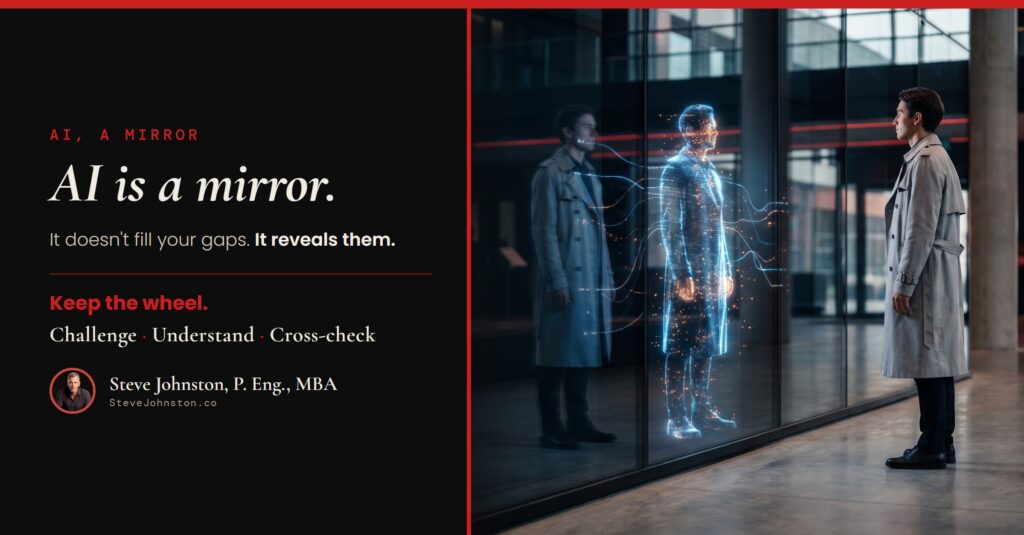
But here is how I read that number. AI is a mirror. It reflects you. It does not fill what you are missing, it amplifies what you already have. If you have judgment and knowledge, you use them to challenge it, correct its answers, spot what is off. If the depth is not there yet, it is easier to take its answer as solid, without seeing what is missing.
Same tool, two opposite results. The difference is not in the tool. It is in the person in front of the screen.
And that is excellent news. Because if you have judgment and experience, AI does not threaten you: it propels you. It takes what you already know and multiplies it. A mirror with something to reflect magnifies everything you give it. That is why “three times less accurate” is not a fate. It is what happens when you have nothing to push back with. Bring judgment to the table, and the same number flips the other way.
What I experience every day
My go-to tool is Claude. I work with it all day long.
And several times a day, I push back. I tell it no, that does not hold, do it again. I catch a claim that looks solid but that I know is wrong, because I have lived through it in the field. I correct, I reframe, I decide.
Every time, the same thought crosses my mind. If I did not have the years of experience I have today, I would not see the flaw. I would take the answer at face value. I would follow it. And I would hit a wall.
It is not AI that saves me from that wall. It is what I already know.
The tricky part, and why there is hope
There is one thing I keep turning over in my head. AI is often in the hands of the youngest, the most comfortable with technology. That is a real strength. But experience does not download: it is a filter that takes years to build. AI, on the other hand, arrives right away, before the filter is ready.
This is not about recklessness. It is simply that the reflection is riskier when you have less perspective to correct it.
And if you lead a team, the answer is not to keep your less experienced people away from AI. That would cut them off from a powerful accelerator. The answer is to lend them the collective judgment of the organization while their own is being built. You coach, you guide, you review. That is where one person’s experience becomes another’s safety net.
Three small habits to make the mirror work for you
You do not need twenty years in the trade to keep your hands on the wheel. Three habits are enough, and you can start Monday.
1. Challenge one answer a day. Ask the AI: “What could be wrong here?” Judgment is a muscle you keep in shape. Once a day is enough to never fall asleep at the wheel.
2. Keep the why. Never ship an answer you could not explain yourself. If you know why it is right, the AI just saved you time. If you do not, you are not done yet.
3. Borrow other people’s judgment. On what matters, have it reviewed by someone more experienced. The team’s filter covers what yours does not have yet. That is not an admission of weakness. It is good hygiene.
What to take away
The takeaway: AI proposes, and we are the ones who decide.
Judgment is not a luxury you add on top of AI. It is the filter without which it amplifies us in the wrong direction. On anything that involves a client, money or our reputation, an AI answer is a starting point, not the final word.
And what we do differently, starting this week: we keep the right to doubt. “I don’t know” is not a weakness to hide. It is the reflex that makes us check before we leap, and it is the one thing the machine will never do for us.
Keep that reflex, and AI becomes exactly what it should be: an engine that drives you forward, not a pilot that decides for you.
A small challenge for this week. Take an AI answer you were about to use as is. Before you do, challenge it once: ask it why, look for the flaw, push one notch further. You will quickly see whether you had what it takes to correct it, or whether you were missing a piece.
To get the weekly analysis on AI and digital transformation for SMB leaders, subscribe to L’Architecte (in French).
